
Free delivery on orders over $300
Same-day shipping available
Order before 11AM for same-day dispatch
Free delivery on orders over $300
Same-day shipping available
Order before 11AM for same-day dispatch
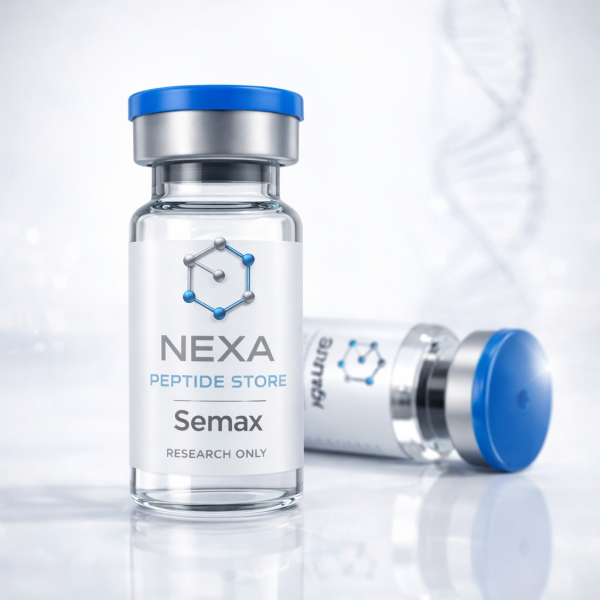
Semax
$61.00
Research Use Only. Semax is sold exclusively for laboratory and in-vitro research purposes. It is not a drug, dietary supplement, or cosmetic, and it is not intended for human or animal administration, diagnosis, treatment, cure, or prevention of any disease or condition.
If you’ve spent any real time sourcing research peptides, you already know the feeling: a vendor page full of confident claims, a “certificate of analysis” that’s really just a stock PDF with the batch number swapped out, and no way to tell if what’s in the vial matches what’s on the label. We built this Semax page the way we’d want it built if we were the ones ordering — with the chemistry, the regulatory picture, and the sourcing verification laid out plainly, so you can make an informed call before you buy.
What Is Semax?
Semax is a synthetic heptapeptide first developed in Russia in the 1980s at the Institute of Molecular Genetics, built as a structural analogue of a fragment of adrenocorticotropic hormone (ACTH). Specifically, it’s derived from ACTH(4-10) — the sequence Met-Glu-His-Phe-Arg-Trp-Gly — with the C-terminal residues replaced by a Pro-Gly-Pro tripeptide, giving Semax its full sequence: Met-Glu-His-Phe-Pro-Gly-Pro.
That Pro-Gly-Pro addition matters. It’s the same tripeptide fragment released during enzymatic breakdown of certain neurotrophic proteins, and researchers have investigated whether it contributes to Semax‘s stability and its reported activity in preclinical neurochemistry models — without the corticotropic (adrenal-stimulating) effects of the parent ACTH fragment.
Key Identifiers
- CAS Number: 80714-61-0
- Molecular Formula: C37H51N9O10S
- Molecular Weight: 813.9 g/mol
- Sequence: Met-Glu-His-Phe-Pro-Gly-Pro
- Synonyms / semantic variants: Semax peptide, Semax acetate, ACTH(4-7)-PGP, MEHFPGP, heptapeptide Semax
Semax acetate (a common salt form used in research formulations) carries its own registry identity — CAS 2828433-33-4, molecular formula C39H55N9O12S, MW ~874.0 g/mol — so when you’re comparing vendors, check which form is actually referenced on the COA.
What the Research Shows
Semax has been the subject of preclinical and clinical neurochemistry research for close to four decades, primarily out of Russian research institutions, with a growing body of newer international literature. A few findings from the published record:
Rodent studies have investigated Semax‘s interaction with brain dopaminergic and serotoninergic systems. A widely-cited neurochemistry paper found that Semax activated dopaminergic and serotoninergic brain systems in rodent models, proposed as a mechanism relevant to its nootropic classification in the preclinical literature.
A 2025 paper in Acta Naturae examined Semax and a derivative compound in an animal model of Alzheimer’s disease, reporting on their potential for correcting pathological impairments observed in that model — a useful signal of where current international research interest is heading, more than four decades after the compound was first synthesized ).
Clinical-stage research conducted in Russia has also examined Semax in the context of ischemic stroke recovery protocols, published in a Russian neurology journal (Gusev et al., Zhurnal Nevrologii i Psikhiatrii, 2018) — research conducted under Russian clinical and regulatory frameworks, not the U.S. framework this product ships under.
Mechanistically, the literature on Semax points to several proposed pathways under investigation: interaction with melanocortin receptors, inhibition of enkephalin-degrading enzymes (extending the half-life of endogenous enkephalins), and upregulation of brain-derived neurotrophic factor (BDNF) expression in preclinical models. None of this is settled human-therapeutic science in the U.S. regulatory sense — it’s an active, evolving research area, which is exactly why sourcing a verifiably pure, correctly-identified compound matters if you’re the one running the assay.
Regulatory Context (U.S.)
Semax has never been FDA-approved for any use in the United States. It was nominated for inclusion on FDA’s Section 503A bulk drug substances list for compounding; that nomination was subsequently withdrawn, and FDA opted to evaluate the substance on its own initiative. At its July 2026 meeting, the Pharmacy Compounding Advisory Committee voted to recommend adding Semax (free base and acetate) to the 503A list but this is a non-binding recommendation. FDA itself has stated there is “insufficient evidence of effectiveness to support use of semax… for cerebral ischemia, migraine, or trigeminal neuralgia,” and formal rulemaking has not concluded (FDA PCAC Briefing Document, July 2026). In short: not approved, not currently listed, status still pending final agency action.
Regulatory Context (Russia)
Separately from any U.S. determination, Semax has been included on Russia’s official List of Vital and Essential Drugs, most recently referenced under Government Decree No. 2406-r (October 12, 2019) — a fact of Russian pharmaceutical regulatory history, not a claim about U.S. legal status or human safety/efficacy.
Anti-Doping Context
Semax does not appear by name on the current WADA Prohibited List. Corticotropin-fragment analogues and non-approved substances more broadly are addressed through catch-all categories (S0 and S2), so athletes or research subjects working under anti-doping jurisdiction should verify current guidance with their anti-doping organization directly rather than relying on the absence of a name match.
Purity, COA, and Third-Party Testing
Every batch of Semax we list ships with a batch-specific Certificate of Analysis from independent third-party testing — not a template PDF that gets reused across lots. The COA reports HPLC purity, confirms identity against the expected mass spectrum, and documents any detectable residual solvents. You should never have to take a purity percentage on faith, and you shouldn’t have to email support and wait three days for a document that should already be attached to your order.
We’d be lying if we said every vendor in this space operates this way. Plenty don’t — and if you’ve ever gotten a vial back from a “verified” supplier only to find the accompanying COA was dated eight months before the batch you actually received, you know exactly the trust gap we’re talking about. Our COAs are matched to the specific lot in your shipment, not a representative sample from whenever the compound was last tested.
Full batch-level COA documentation for Semax and every compound we carry is available in our COA & Lab Reports library — search by lot number before you order, not after.
Sourcing and Verification
Before you buy Semax — or any research peptide — from any supplier, a short verification checklist saves a lot of downstream frustration:
Confirm the COA is batch-specific and matches the lot number physically printed on your vial or shipping label, not just “representative” of the product line. Confirm the testing method (HPLC-UV, mass spec, or both) and that purity is reported as a specific percentage, not a vague “high purity” claim. Confirm the molecular identity data (mass, sequence) on the COA actually matches the published identifiers for Semax — CAS 80714-61-0, C37H51N9O10S. And confirm the supplier is explicit, in writing, that the product is sold for research use only and is not intended for human or animal use.
Our full sourcing, testing, and research-use terms are detailed in our store policies, and background on how we select and vet manufacturing partners is available on our research standards page. If a research peptide vendor won’t show you any of this before you place an order, that’s information too.
Storage and Handling
Lyophilized (freeze-dried) Semax should be stored at -20°C for long-term stability, protected from light and moisture, and kept in its original sealed container until use. Under these conditions, lyophilized peptide is generally stable for extended periods.
Once reconstituted for laboratory/research use, Semax solutions are substantially less stable and should be stored at 2-8°C, used within the timeframe established by your lab’s own protocols, and never refrozen after thawing, as repeated freeze-thaw cycles accelerate peptide degradation. As with all research compounds, always consult current laboratory safety data and your institution’s handling protocols — this information is provided for general research-storage context only and is not a substitute for your own lab’s SOPs.
Want the full research and regulatory picture before you order? Our Semax research deep-dive walks through the FDA’s 2026 advisory committee review, the published literature, and exactly what to check on a COA before you buy from anyone.
Frequently Asked Questions About Semax
Is Semax approved by the FDA?
No. Semax has never been FDA-approved for any human or animal use. A nomination for inclusion on FDA’s 503A bulk drug substances list was withdrawn, and while a 2026 advisory committee recommended adding it, formal agency action has not concluded.
What is the CAS number for Semax?
80714-61-0 for the free base form. Semax acetate, a different salt form, is registered separately under CAS 2828433-33-4.
What is the molecular formula and weight of Semax?
C37H51N9O10S, with a molecular weight of approximately 813.9 g/mol.
Is Semax the same as Semax acetate?
No. They’re related but distinct forms with different CAS numbers and molecular weights (Semax acetate: C39H55N9O12S, ~874.0 g/mol). Always check which form your COA is reporting on.
What is the amino acid sequence of Semax?
Met-Glu-His-Phe-Pro-Gly-Pro — derived from the ACTH(4-10) fragment with the terminal residues replaced by a Pro-Gly-Pro tripeptide.
Is Semax legal to purchase in the United States?
Semax is sold in the U.S. as a research chemical for laboratory and in-vitro use only, not as a drug or supplement for human consumption. It is not FDA-approved. Buyers are responsible for understanding and complying with all applicable laws and regulations in their jurisdiction.
Is Semax banned by WADA?
Semax is not individually named on the current WADA Prohibited List. It may fall under broader catch-all categories covering non-approved substances or peptide/corticotropin-related compounds. Anyone subject to anti-doping testing should confirm current status directly with their anti-doping organization.
Do you provide a Certificate of Analysis with Semax orders?
Yes. Every batch ships with a lot-specific, third-party COA reporting HPLC purity and mass-spec identity confirmation. You can also look up COAs by batch number in our COA & Lab Reports library before ordering.
How should Semax be stored?
Lyophilized Semax should be stored at -20°C, protected from light and moisture. Reconstituted solutions used in research settings should be kept at 2-8°C and not subjected to repeat freeze-thaw cycles.
What research has been published on Semax?
Published research includes rodent neurochemistry studies on dopaminergic/serotoninergic system activation (Eremin et al., 2005), a 2025 Alzheimer’s disease animal-model study (Radchenko et al., Acta Naturae), and Russian clinical-stage research in ischemic stroke recovery contexts (Gusev et al., 2018). All are preclinical or non-U.S. clinical research — none constitute FDA-reviewed evidence for any human use.
Is Semax included on any government drug lists?
Yes, separately from any U.S. determination — Semax is included on Russia’s official List of Vital and Essential Drugs, most recently referenced under Government Decree No. 2406-r (2019). This reflects Russian pharmaceutical regulatory history and has no bearing on U.S. legal or regulatory status.
Do you sell Semax for injection or human use?
No. We sell Semax exclusively for laboratory and in-vitro research purposes. We do not provide dosing, reconstitution-for-administration, or administration guidance of any kind, and the product is not intended for human or animal use.
You Might Also Be Researching
For related cognitive and neuropeptide research compounds, see Selank and DSIP, or browse our full Cognitive Research category.
Research background
Research use only. Not for human or animal consumption.
4 reviews for Semax
Only logged in customers who have purchased this product may leave a review.
Related products

Selank Peptide
$61.00DSIP
$52.00
Avery (verified owner) –
Customer support answered all my questions quickly.
Nicholas (verified owner) –
Fast shipping and excellent communication.
Joshua Scott (verified owner) –
The ordering process was simple and efficient.
Anthony (verified owner) –
Reliable brand with great customer support.