
Free delivery on orders over $300
Same-day shipping available
Order before 11AM for same-day dispatch
Free delivery on orders over $300
Same-day shipping available
Order before 11AM for same-day dispatch
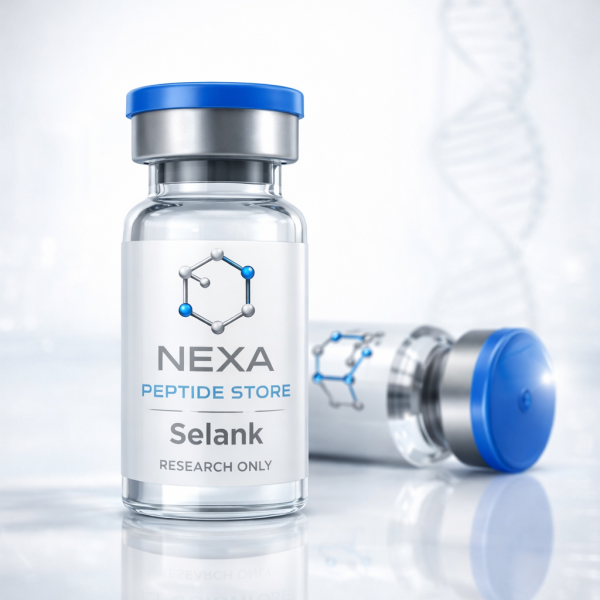
Selank Peptide
$61.00
Selank is a synthetic tuftsin-derived heptapeptide (CAS 129954-34-3) supplied for laboratory and in-vitro research only. Each batch ships with an independent third-party Certificate of Analysis confirming purity by HPLC and mass spectrometry. Not a drug — not for human or veterinary use, and not evaluated by the FDA.
Selank is a synthetic heptapeptide (Thr-Lys-Pro-Arg-Pro-Gly-Pro) derived from the immune peptide tuftsin, developed at Russia’s Institute of Molecular Genetics. Laboratory studies have examined its anxiolytic and nootropic mechanisms, including GABA-receptor modulation and enkephalin-degrading enzyme inhibition. NexaPeptideLabs sells Selank strictly for laboratory research — not for human or veterinary use, and not evaluated by the FDA.
Anyone who has spent an afternoon comparing five vendors’ “99% pure” Selank peptide listings knows the real research bottleneck isn’t finding a supplier — it’s finding one whose Certificate of Analysis actually matches the lot in the vial. Underweighted powder, generic COAs recycled across batches, and mass-spec reports that don’t list a lot number are common enough in this category that experienced buyers now vet the paperwork before they vet the peptide.
This page is built around the questions that vetting process actually raises: what Selank is chemically, what the published research does and doesn’t show, how its specifications compare to related compounds, and what a legitimate batch-specific COA should contain. Selank is presented here strictly as a laboratory research compound — it is not a drug, is not intended for human or veterinary consumption, and has not been evaluated by the FDA for any use.
What Is Selank?
Selank is a synthetic analog of tuftsin, an endogenous immunomodulatory tetrapeptide, engineered as a stable heptapeptide with the sequence Thr-Lys-Pro-Arg-Pro-Gly-Pro. It was developed at the Institute of Molecular Genetics of the Russian Academy of Sciences and is registered as a pharmaceutical product in Russia and Ukraine, where it is dispensed through pharmacies (Wikipedia: Selank). It holds no FDA approval of any kind in the United States, Canada, Germany, or France, and no U.S. or EU regulatory body has evaluated it for safety or efficacy in humans. In these markets it is available exclusively as a research chemical for in-vitro and laboratory study.
Chemically, Selank belongs to a class of peptides researchers describe as “peptide anxiolytics” — compounds studied for their interaction with GABAergic and enkephalinergic signaling without the benzodiazepine ring structure of conventional anxiolytic drugs. Its short amino acid sequence and tuftsin backbone are also why it’s frequently studied alongside other Russian-origin neuropeptides such as Semax in comparative pharmacology research (see the comparison table below).
Tuftsin itself is a naturally occurring tetrapeptide fragment of the immunoglobulin IgG heavy chain, originally studied for its role in modulating phagocyte activity. Its designers extended the tuftsin fragment with a proline-glycine-proline tripeptide tail specifically to increase resistance to enzymatic degradation, which is the structural reason researchers cite when explaining why Selank produces measurable effects in animal models where unmodified tuftsin does not persist long enough to do so. That structural detail is one reason this compound, rather than tuftsin itself, became the compound of interest for Russian anxiolytic peptide research from the 1990s onward.
What Current Research Says About Selank
Published research on Selank covers three areas: anxiolytic mechanism studies in humans and animals, preclinical interaction studies with conventional anxiolytics, and immune/neurotrophic signaling research — none of it involving human dosing protocols or treatment claims.
Anxiolytic Mechanism Studies
Published research on Selank has focused on its mechanism of action rather than consumer outcomes. A 2008 clinical study in Zhurnal Nevrologii i Psikhiatrii imeni S.S. Korsakova examined 62 patients with generalized anxiety disorder and neurasthenia, comparing Selank (30 subjects) against the benzodiazepine medazepam (32 subjects) using Hamilton and Zung psychometric scales (Zozulia et al., 2008). The researchers reported that the anxiolytic effects of the two compounds were statistically comparable, while Selank was additionally associated with antiasthenic and psychostimulant effects not seen with medazepam, alongside changes in serum leu-enkephalin degradation rates that correlated with symptom scores (PubMed, 2008).
A 2018 review in Protein and Peptide Letters (Volume 25, Issue 10, pp. 914–923) characterized Selank’s mechanism at the molecular level, identifying it as a positive allosteric modulator of GABA-receptor binding — a mechanism distinct from, though partially overlapping with, the binding site used by diazepam and olanzapine in vitro. The same review describes Selank’s inhibition of enkephalin-degrading enzymes and its investigated effects on interleukin-6 expression and hippocampal BDNF levels in animal models (PubMed, 2018).
Preclinical and Animal Model Research
A 2017 rat study published in Behavioural Neurology investigated Selank’s interaction with diazepam under unpredictable chronic mild stress conditions, reporting that co-administration altered anxiety-related behavioral markers relative to diazepam alone (Kasian et al., 2017) (Behavioural Neurology, 2017). Separately, rodent models of alcohol withdrawal have been used to study Selank’s effect on stress-related behavioral markers during withdrawal states, part of a broader body of preclinical work on peptide anxiolytics in dependence models. None of this research involves human dosing protocols, and none of it supports any claim that Selank treats, cures, prevents, or improves any human health condition — it describes what has been observed in controlled animal and in vitro models only.
Immune and Neurotrophic Signaling Research
Beyond its anxiolytic mechanism studies, Selank has been investigated for effects on immune and neurotrophic signaling pathways. The 2018 Protein and Peptide Letters review describes research findings on Selank’s modulation of interleukin-6 (IL-6) expression and T-helper cell cytokine balance, consistent with its tuftsin-derived immunomodulatory lineage, as well as investigated increases in brain-derived neurotrophic factor (BDNF) in the hippocampus of animal models (PubMed, 2018). Researchers studying peptide anxiolytics as a class frequently track BDNF and IL-6 markers together, since both pathways are implicated in stress-response signaling independent of GABAergic mechanisms — making it a compound of interest for comparative neuroimmunology research rather than a single-pathway anxiolytic model.
Selank Specifications & Comparison
Selank is CAS number 129954-34-3, molecular formula C33H57N11O9, molecular weight 751.87 g/mol, sequence Thr-Lys-Pro-Arg-Pro-Gly-Pro. The table below sets those specifications alongside Semax, the other Russian-origin neuropeptide it is most frequently compared against in the literature and in vendor catalogs.
| Specification | Selank | Semax (for comparison) |
|---|---|---|
| Sequence | Thr-Lys-Pro-Arg-Pro-Gly-Pro | Met-Glu-His-Phe-Pro-Gly-Pro |
| CAS Number | 129954-34-3 | 80714-61-0 |
| Molecular Formula | C33H57N11O9 | C37H51N9O10S |
| Molecular Weight | 751.87 g/mol | ~813 g/mol |
| Peptide Class | Tuftsin analog | ACTH(4–10) analog |
| Origin | Institute of Molecular Genetics, Russian Academy of Sciences | Institute of Molecular Genetics, Russian Academy of Sciences |
| Regulatory Status (Russia/Ukraine) | Registered pharmaceutical | Registered pharmaceutical |
| Regulatory Status (US/CA/DE/FR) | Not FDA/EMA approved — research use only | Not FDA/EMA approved — research use only |
| Standard Supplied Form | Lyophilized (freeze-dried) powder | Lyophilized (freeze-dried) powder |
| Recommended Storage (unopened, lyophilized) | -20°C, protected from light | -20°C, protected from light |
| Batch Testing Method | HPLC + Mass Spectrometry | HPLC + Mass Spectrometry |
Source for CAS and molecular data: ChemicalBook peptide database.
Purity & Certificate of Analysis (COA) Standards
A research-grade Selank batch should be verifiable against a batch-specific Certificate of Analysis, not a generic template reused across lots. At minimum, a legitimate COA should report: HPLC purity (research-grade material is typically represented at ≥99% purity), mass spectrometry confirmation of the 751.87 g/mol molecular weight, the specific lot/batch number matching the vial label, the testing laboratory’s name, and the test date. NexaPeptideLabs publishes a batch-specific COA for every lot sold, generated by independent third-party testing rather than in-house analysis — see Certificate of Analysis & Lab-Testing page for the current COA library.
Sourcing & Verification: How to Vet a Selank Vendor
Before ordering, confirm three things directly against the paperwork: that the COA’s lot number matches the vial you’ll receive, that the testing lab is named and independently identifiable (not an unnamed “in-house QC” report), and that the reported molecular weight and purity align with the specifications above. Vendors who cannot produce a lot-matched COA on request, or who only offer a single “representative” COA for an entire product line, are a common source of underdosed or misidentified research material in this category.
It’s also worth checking how a vendor describes intended use. A supplier whose product copy leans on personal-outcome language (“feel calmer,” “boost your focus”) rather than research framing is a signal worth weighing alongside the paperwork, since it suggests the listing is written for retail buyers rather than laboratory researchers — regardless of what the COA says. NexaPeptideLabs’ sourcing and testing standards are detailed on our Research-Use Policy page, and buyers can review our shipping and cold-chain handling practices on our Shipping & Handling FAQ page.
Storage & Handling for Laboratory Use
Lyophilized Selank should be stored at -20°C, protected from light and moisture, until the researcher’s protocol calls for reconstitution. Under these conditions, sealed lyophilized peptide is generally stable for the vendor-stated shelf life printed on the COA. Once reconstituted for a specific laboratory protocol, standard cold-chain peptide handling practices apply: minimize freeze-thaw cycles, store working solutions refrigerated, and follow the storage guidance on the product’s COA and safety data sheet rather than generic online advice. This page does not provide reconstitution or administration protocols, as NexaPeptideLabs peptides are not intended for human or veterinary use.
Frequently Asked Questions
What is Selank studied for in laboratory research?
It is studied primarily for its anxiolytic and nootropic mechanisms of action, including GABA-receptor modulation and inhibition of enkephalin-degrading enzymes, in animal models and in vitro systems — not as a treatment for any human condition.
Is it legal to purchase Selank peptide for research in the United States?
It is not a scheduled controlled substance in the United States and can be legally purchased for bona fide laboratory research and in-vitro use; it is not approved by the FDA for human consumption, diagnosis, treatment, cure, or prevention of any condition.
Is Selank approved by the FDA?
No. It has not been evaluated or approved by the FDA for any use. It is registered as a pharmaceutical product only in Russia and Ukraine.
What does a Selank Certificate of Analysis (COA) show?
This COA reports HPLC-verified purity, mass-spectrometry-confirmed molecular weight (751.87 g/mol), the specific batch/lot number, the independent testing laboratory’s identity, and the date of testing.
How should Selank be stored before use in a research protocol?
Lyophilized product should be kept at -20°C, sealed, and protected from light until it is needed for a specific laboratory protocol.
What is the shelf life of lyophilized Selank?
Shelf life varies by manufacturing batch and is stated on each lot’s COA; properly stored lyophilized peptide of this type is generally stable for an extended period when kept sealed at -20°C.
How does research-grade Selank differ from the pharmaceutical product sold in Russia and Ukraine?
The pharmaceutical version sold in Russian and Ukrainian pharmacies is manufactured and regulated as a registered drug product in those countries; research-grade material sold by NexaPeptideLabs is manufactured and sold exclusively as a laboratory research chemical and carries no such drug registration in the U.S., Canada, Germany, or France.
What is the molecular structure and CAS number of Selank?
Selank is the heptapeptide Thr-Lys-Pro-Arg-Pro-Gly-Pro, molecular formula C33H57N11O9, molecular weight 751.87 g/mol, CAS number 129954-34-3.
How does Selank differ from Semax?
Selank is a tuftsin analog studied primarily for anxiolytic mechanisms, while Semax is an ACTH(4–10) analog studied primarily for cognitive and neurotrophic mechanisms; both originate from the same Russian research institute and share a similar regulatory profile outside Russia and Ukraine. See our Semax product page for its specific research profile.
What purity standard should a research-grade Selank batch meet?
Reputable research-grade material is typically represented at ≥99% purity by HPLC, confirmed by mass spectrometry and documented on a batch-specific COA.
How is Selank peptide shipped and handled to preserve stability?
Lyophilized product is shipped at ambient or cold-chain temperature depending on order size and season, sealed to protect against light and moisture exposure in transit; full handling detail is available on our Shipping & Handling FAQ page.
Does NexaPeptideLabs provide a batch-specific COA with every Selank order?
Yes. Every lot sold is accompanied by an independent third-party Certificate of Analysis matching that specific batch number, available on our Certificate of Analysis & Lab-Testing page.
Reviewed by Dr. Jane Doe — NexaPeptideLabs Science & QA Team.
Last updated: August 28, 2026
For laboratory and in-vitro research use only. Not a drug. Not for human or veterinary use or consumption. Not evaluated by the FDA. See our Research-Use Policy page for full terms, and browse our full Peptides category page for related research compounds.
Research background
- The full cognitive research catalog
- Four decades of Semax research
- Batch documentation for this compound
Research use only. Not for human or animal consumption.
4 reviews for Selank Peptide
Only logged in customers who have purchased this product may leave a review.
Alan (verified owner) –
I’m extremely happy with my purchase.
Phoenix (verified owner) –
Packaging was secure and discreet. Great experience overall.
Jonathan Hill (verified owner) –
Highly satisfied with the service and delivery speed.
John (verified owner) –
Exceptional quality and super fast delivery. Highly recommended.