Free delivery on orders over $300
Same-day shipping available
Order before 11AM for same-day dispatch
Free delivery on orders over $300
Same-day shipping available
Order before 11AM for same-day dispatch
Free delivery on orders over $300
Same-day shipping available
Order before 11AM for same-day dispatch
Free delivery on orders over $300
Same-day shipping available
Order before 11AM for same-day dispatch
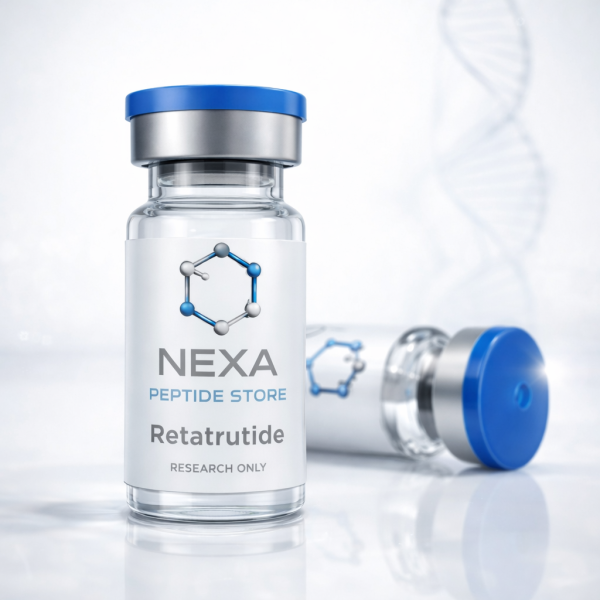
Research Use Only. Retatrutide as sold on this page is a laboratory research chemical, not a drug, dietary supplement, or cosmetic. It is not FDA-approved, has not been evaluated for safety or efficacy by any regulatory body, and is not intended for human or animal use, consumption, diagnosis, treatment, cure, or prevention of any disease or condition. Under federal law, retatrutide cannot be used in compounding and is not a component of any FDA-approved drug.
Retatrutide is a synthetic 39-amino-acid peptide, identified in the literature as LY3437943, engineered as a triple hormone receptor agonist — activating the glucagon-like peptide-1 (GLP-1), glucose-dependent insulinotropic polypeptide (GIP), and glucagon (GCGR) receptors in a single molecule. It carries CAS registry number 2381089-83-2 and is currently in Phase 3 clinical development, not FDA-approved for any indication. The retatrutide sold here is a non-pharmaceutical-grade research compound supplied strictly for in-vitro laboratory use.
If you’ve been trying to source retatrutide for research, you’ve probably already noticed the gap between how thin most listings are and how much clinical data actually exists on this molecule. Most vendor pages recycle the same three sentences and call it a day. Given how heavily this specific compound is scrutinized right now — FDA has named retatrutide explicitly in its warning-letter enforcement pattern against research-chemical sellers whose marketing copy strays into implied human benefit — we’d rather over-document the chemistry and under-promise everything else.
Retatrutide Research Overview
What Is Retatrutide?
Retatrutide (LY3437943) is a synthetic peptide engineered as a triple agonist, engaging the glucagon receptor (GCGR), the GIP receptor, and the GLP-1 receptor in one molecule — mechanistically distinct from single- or dual-receptor compounds in the same research class. It carries the CAS registry number 2381089-83-2, ChEMBL ID CHEMBL5095485, and DrugBank ID DB18993. A molecular formula of C221H342N46O68 and molecular weight of approximately 4,731.3 g/mol are reported consistently across commercial chemical-supplier documentation; note that, unlike semaglutide and tirzepatide, retatrutide does not yet carry a discrete computed-property record on PubChem, so buyers should treat these figures as supplier-COA data rather than an independently verified primary registry value until confirmed against your specific batch’s certificate of analysis.
In vitro pharmacology research has characterized retatrutide as showing balanced activity at the glucagon and GLP-1 receptors, with comparatively greater activity at the GIP receptor (Coskun et al., Cell Metabolism, September 2022, PMID 35985340). Semantic and formulation variants researchers may encounter include LY3437943 (its development code) and “triple hormone receptor agonist” or “GIP/GLP-1/glucagon triple agonist” as descriptive shorthand.
What Current Research Shows
Retatrutide’s discovery and mechanistic characterization were first published by Coskun et al. in Cell Metabolism (September 2022, PMID 35985340), describing preclinical work in diet-induced obese mouse models in which weight-related outcomes were attributed to glucagon-receptor-driven increases in energy expenditure combined with GIP- and GLP-1-receptor-driven changes in caloric intake — a three-pathway mechanism distinct from single-target compounds.
Clinical-stage research on the pharmaceutical development compound has since expanded substantially. A Phase 2 trial in adults with obesity, published in the New England Journal of Medicine in August 2023, reported dose-dependent body-weight changes at 48 weeks (Jastreboff et al., NEJM, August 10, 2023, PMID 37366315). A 2025 substudy in The Lancet Diabetes & Endocrinology examined body-composition effects in people with type 2 diabetes (Coskun et al., PMID 40609566), and a 2025 systematic review in the Journal of Basic and Clinical Physiology and Pharmacology summarized the accumulated clinical-trial evidence base (Misra et al., PMID 40728138).
It’s important to be precise about what this research covers. These findings describe the pharmaceutical development compound under Eli Lilly’s clinical trial program (Phase 3 studies, publicly designated TRIUMPH and TRANSCEND) — not any unregulated, non-pharmaceutical-grade research compound sold outside that program. As of this writing, retatrutide is not FDA-approved for any use; Lilly has indicated it intends to file for approval in 2027. The compound described on this page is not studied, dosed, or intended for human use in any capacity.
Retatrutide Specifications & Comparison
Property
Retatrutide
Semaglutide
Tirzepatide
CAS Number
2381089-83-2
910463-68-2
2023788-19-2
Molecular Formula
C221H342N46O68 (supplier-reported)
C187H291N45O59
C225H348N48O68
Molecular Weight
~4,731.3 g/mol (supplier-reported)
~4,113.6 g/mol
~4,813.5 g/mol
Receptor Target(s) Studied
GIP + GLP-1 + glucagon receptors (triple agonist)
GLP-1 receptor (single agonist)
GIP + GLP-1 receptors (dual agonist)
FDA Status
Not approved; Phase 3 development
Approved (as Ozempic/Wegovy/Rybelsus) — not this RUO form
Approved (as Mounjaro/Zepbound) — not this RUO form
Storage (lyophilized)
-20°C, protected from light/moisture
-20°C, protected from light/moisture
-20°C, protected from light/moisture
Batch Testing Method
HPLC + mass spectrometry
HPLC + mass spectrometry
HPLC + mass spectrometry
Retatrutide’s three-receptor mechanism is structurally and pharmacologically distinct from both semaglutide’s single-receptor activity and tirzepatide’s dual-receptor activity — treat all three as related but non-interchangeable compounds, each requiring independent COA and identity verification. Related research listings: Semaglutide and Tirzepatide.
Purity, COA, and Third-Party Testing Standards
Every batch of retatrutide we list ships with a batch-specific Certificate of Analysis from independent third-party testing, reporting HPLC purity and mass-spectrometry identity confirmation — not a template document recycled across lots.
This matters more for retatrutide than for most research peptides on the market right now. FDA has stated plainly that “retatrutide and cagrilintide cannot be used in compounding under federal law. Additionally, these are not components of FDA-approved drugs and have not been found safe and effective for any condition” (FDA.gov, “FDA’s Concerns with Unapproved GLP-1 Drugs Used for Weight Loss,” current as of June 15, 2026). FDA has also directly named retatrutide in its enforcement pattern against vendors whose “not for human consumption” disclaimers are undercut by marketing copy implying physiological benefit — two 2025-2026 warning letters (GLP-1 Solution, September 2025; Gram Peptides, March 2026) illustrate this precedent clearly. We source, test, and describe this compound accordingly: as a chemical entity defined by its identifiers, not by any claimed effect.
Full batch-level COA documentation for retatrutide and every compound we carry is available in our COA & Lab Reports library — searchable by lot number before you order.
Sourcing and Verification
Before you buy retatrutide — or any triple-agonist research peptide — from any supplier, verify a few things directly. Confirm the COA is batch-specific and matches the lot number on your actual shipment, not a “representative” sample. Confirm the testing method (HPLC, mass spec, or ideally both) and that purity is reported as a specific percentage tied to that batch. Confirm the molecular identity data on the COA is internally consistent with the CAS number 2381089-83-2, since retatrutide currently lacks a discrete third-party registry record independent of supplier documentation — meaning your vendor’s own testing is the primary check available to you.
It’s also worth understanding the current enforcement landscape before choosing a vendor: FDA has already issued warning letters naming retatrutide specifically, targeting sellers whose product pages pair “research use only” language with claims about appetite, metabolism, or body composition. A vendor that blurs that line in its marketing is a vendor whose COAs deserve extra scrutiny. Our full sourcing, testing, and research-use terms are detailed in our store policies; browse related compounds in our Metabolic Research category.
Storage and Handling
Lyophilized (freeze-dried) retatrutide should be stored at -20°C, protected from light and moisture, and kept in its original sealed container until use; under these conditions lyophilized peptide is generally stable for extended periods. Once reconstituted for laboratory/research use, solutions are substantially less stable and should be kept at 2-8°C, used within the timeframe set by your lab’s own protocols, and never subjected to repeat freeze-thaw cycles, which accelerate peptide degradation. This is general research-storage context only, not a substitute for your institution’s own SOPs or current laboratory safety data.
Is retatrutide for sale here the same as any FDA-approved drug?
No. Retatrutide is not FDA-approved for any indication and is not a component of any approved drug. It remains in Phase 3 clinical development. The retatrutide sold on this page is a separate, non-pharmaceutical-grade research compound sold strictly for laboratory use.
What is the CAS number for retatrutide?
2381089-83-2. Retatrutide also carries ChEMBL ID CHEMBL5095485 and DrugBank ID DB18993.
What is the molecular formula and weight of retatrutide?
A molecular formula of C221H342N46O68 and molecular weight of approximately 4,731.3 g/mol are consistently reported by chemical suppliers; retatrutide does not yet have a discrete computed-property record on PubChem, so treat these figures as supplier/COA-sourced rather than independently registry-verified.
Can retatrutide legally be used in compounding?
No. FDA has stated explicitly that retatrutide cannot be used in compounding under federal law and is not a component of any FDA-approved drug.
Is it legal to buy retatrutide for research in the United States?
Retatrutide research compound is sold for laboratory and in-vitro use only, not as a human drug or supplement. It is not FDA-approved. Buyers are responsible for confirming compliance with applicable laws in their own jurisdiction.
What does a Certificate of Analysis for retatrutide show?
A COA should report HPLC purity as a specific percentage, mass-spectrometry confirmation of molecular identity, and a batch/lot number matching your shipment.
How does retatrutide differ mechanistically from semaglutide or tirzepatide?
Retatrutide is a triple agonist activating GIP, GLP-1, and glucagon receptors. Semaglutide is a selective GLP-1 receptor agonist. Tirzepatide is a dual agonist activating GIP and GLP-1 receptors only, without glucagon-receptor activity.
What clinical-stage research has been published on retatrutide?
Peer-reviewed publications include the original mechanistic characterization (Coskun et al., 2022, PMID 35985340), a Phase 2 obesity trial (Jastreboff et al., NEJM, 2023, PMID 37366315), a 2025 body-composition substudy (Coskun et al., PMID 40609566), and a 2025 systematic review (Misra et al., PMID 40728138). This research describes the pharmaceutical development compound under clinical trial protocols, not any research-grade compound sold outside that program.
Has the FDA taken enforcement action related to retatrutide sold by research vendors?
Yes. FDA has issued warning letters naming retatrutide directly, including to GLP-1 Solution (September 2025) and Gram Peptides (March 2026), both citing marketing language that implied physiological effects despite “not for human consumption” disclaimers.
Do you provide dosing or administration guidance for retatrutide?
No. We do not provide dosing amounts, reconstitution-for-administration steps, injection guidance, or cycling protocols of any kind. This product is not intended for human or animal use.
How should retatrutide be stored?
Lyophilized retatrutide should be stored at -20°C, protected from light and moisture. Reconstituted research solutions are less stable and should be kept at 2-8°C, with repeat freeze-thaw cycles avoided.
What shipping and handling standards apply to retatrutide orders?
Our shipping, cold-chain, and research-use terms are detailed in our store policies page, alongside full sourcing and testing standards.
3 reviews for Retatrutide
Rated 5 out of 5
Charles (verified owner)–
Very trustworthy company with great standards.
Rated 5 out of 5
Chris Taylor (verified owner)–
High-quality products and responsive support team.
Rated 5 out of 5
Brandon Adams (verified owner)–
The quality exceeded my expectations.
Only logged in customers who have purchased this product may leave a review.




Charles (verified owner) –
Very trustworthy company with great standards.
Chris Taylor (verified owner) –
High-quality products and responsive support team.
Brandon Adams (verified owner) –
The quality exceeded my expectations.