
Free delivery on orders over $300
Same-day shipping available
Order before 11AM for same-day dispatch
Free delivery on orders over $300
Same-day shipping available
Order before 11AM for same-day dispatch

GHK-CU
$39.00
GHK-CU – Nexa Peptide Labs
GHK-Cu is a copper-binding research peptide studied for its links to cell matrix remodeling, cell signaling, stress response, and tissue repair. This guide explains what researchers mean by ghk copper peptides, why the copper complex matters, and how to judge sourcing and handling without mixing research materials with products meant for people. The main point is simple: the science is interesting, but quality, records, and research-only limits matter as much as the molecule itself.
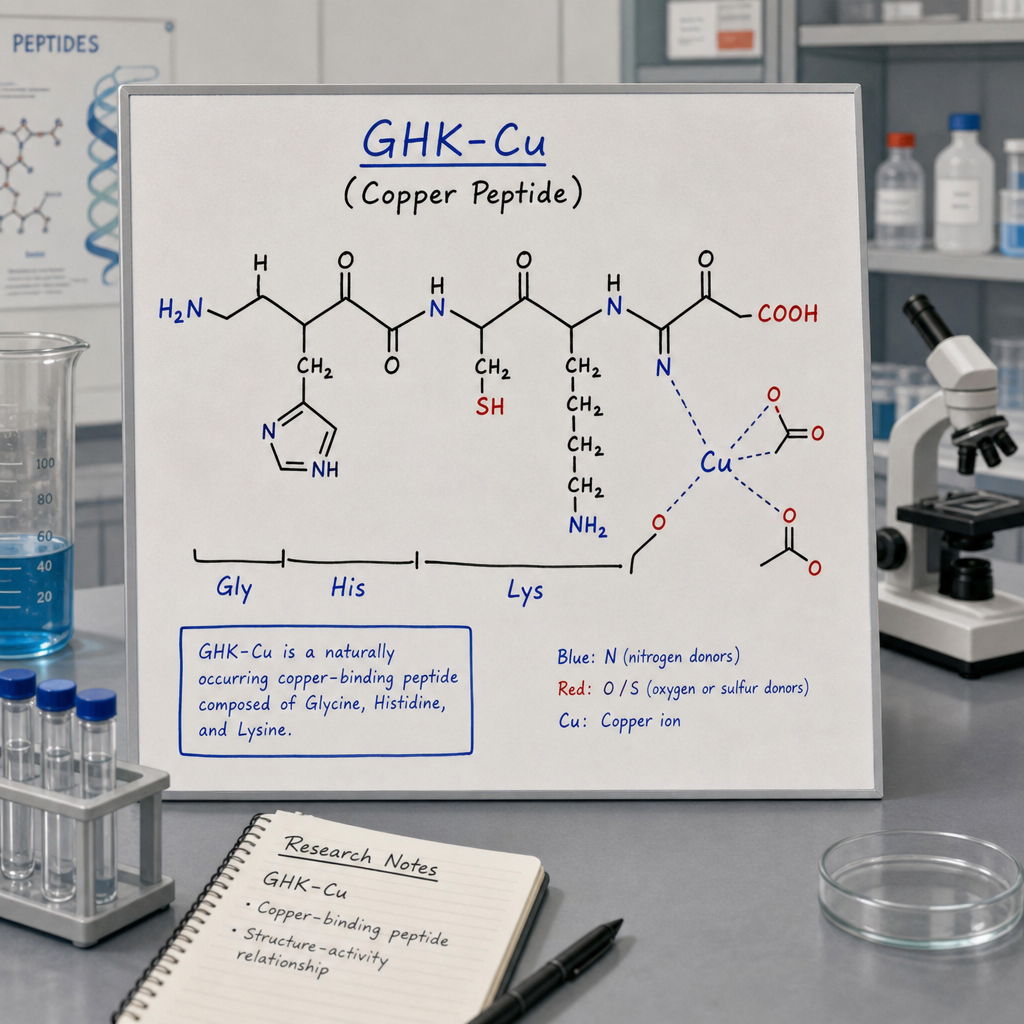
What is ghk cu peptide used for in research?
GHK-Cu peptide is used in lab research to study how a natural tripeptide complex may shape repair signals, cell matrix biology, collagen-linked paths, immune markers, and stress response. The peptide part is glycyl-L-histidyl-L-lysine, often called GHK, and it can bind copper ions to form the GHK-Cu complex. Early and later studies describe GHK as a human plasma peptide with strong copper binding. That is one reason researchers study the ghk cu copper peptide form instead of only the free peptide.
In plain terms, GHK-Cu interests researchers because it sits between peptide signals and copper biology. Copper helps many enzymes and structures. Small peptides can act as short chemical signals. When joined, the molecule has been studied in wound models, fibroblast cultures, skin work, and gene data.
The phrase what is ghk cu peptide used for can sound like a treatment question. Here, the answer is research use: in vitro assays, preclinical models, lab method studies, and early cell and molecular biology. It should not be framed as self-use, an injectable wellness item, or a clinical tip.
The biological appeal of a small copper-binding peptide
GHK-Cu is small, but its research reach is broad. Studies have linked it with connective tissue build-up in wound chambers, collagen output in fibroblast cultures, and GAG production. These findings help explain why many papers and suppliers describe GHK-Cu in relation to cell matrix remodeling rather than as a one-use compound. Cell matrix remodeling matters because the matrix is not just passive support. It shapes how cells attach, move, talk, and react to stress. In wound and skin models, researchers often look at matrix proteins, proteoglycans, fibroblast activity, and immune signaling together because repair depends on coordinated change, not one marker.
GHK-Cu has also drawn interest because gene-expression work suggests that GHK, with or without copper, can affect many genes linked to stress response, inflammation, tissue repair, and remodeling. Reviews that discuss Broad Institute gene data describe wide gene effects, but these results should be read as clues, not proof of clinical benefit.
How does the ghk cu copper peptide work?
The ghk cu copper peptide is thought to work through copper binding, cell-signal effects, and downstream changes in paths tied to repair, inflammation, redox, and matrix turnover. Researchers do not treat it as a simple more collagen switch. A better model is that GHK-Cu may help investigators study how cells balance build, cleanup, and stress during remodeling.
In fibroblast and wound studies, that balance matters. Matrix build includes collagen and GAGs, while matrix remodeling also needs enzymes that break down damaged or extra parts. If a study measures only one end point, it can miss the larger pattern. That is why stronger study plans often use several readouts: cell survival, gene output, protein markers, matrix build, stress markers, and proper controls.
A second point is that GHK-Cu is not the same as every copper ingredient or cosmetic copper peptide label. GHK copper peptides usually mean the GHK tripeptide bound to copper, but labels and listings may use overlapping names, including ghkcu peptide, GHK-Cu, Copper Tripeptide-1, or even misspellings like gku copper peptide. Researchers should verify the real chemical name before assuming two similar listings are the same.
Research uses that draw attention
The most common research interest areas for ghk cu peptide involve skin biology, wound repair models, fibroblast behavior, matrix remodeling, stress, and immune work. Some studies report increased connective tissue build-up in animal wound models, while cell-culture work has looked at collagen and GAG output. These are preclinical or lab findings, not proof that a commercial product will do the same in people.
Useful research uses include:
- Fibroblast and matrix studies. Researchers may use GHK-Cu to look at fibroblast activity, collagen-linked end points, GAG output, or cell matrix makeup.
- Wound-model research. Preclinical wound models can help scientists watch repair markers under control conditions, especially with untreated and vehicle controls.
- Stress and immune tests. Reviews and lab studies discuss GHK-Cu in relation to redox and immune paths, which makes it useful for mechanistic screening.
- Gene work and screening. Because GHK has been tied to broad gene changes, it can help in idea-building work before narrower follow-up tests.
- Compare-peptide work. Scientists may compare GHK-Cu with free GHK or other research peptides to split copper-linked effects from sequence-linked effects.
A practical example: a lab studying dermal fibroblast response might compare untreated cells, vehicle-treated cells, GHK-treated cells, and GHK-Cu-treated cells across several time points. That setup can help show whether the change comes from the peptide sequence, the copper complex, or general culture conditions.
Research-only status should stay clear
GHK-Cu is widely discussed in cosmetic and peptide-research spaces, but a research vial is not the same as an approved medicine. FDA guidance says products meant to treat disease or affect body structure or function are regulated as drugs, while cosmetic products are usually not FDA-approved before sale, except for color additives. (fda.gov)
That difference matters when reading claims online. A supplier page saying GHK-Cu peptide for sale may point to lab material, not a product checked for human safety, dosing, sterility, or therapy. Likewise, cosmetic ingredient language does not show that a research powder is fit for injection, swallowing, or home mixing.
For responsible writing, keep the limit clear: research-grade GHK-Cu is for controlled lab study only. Do not turn in vitro or animal data into personal-use steps, medical claims, or sure results.

What should you check before you buy copper peptide ghk cu?
Before you buy copper peptide ghk cu for lab work, check identity tests, purity data, batch records, storage terms, and whether the supplier clearly limits the material to research use. A low ghk-cu peptide price is not useful if the vial lacks strong lab support or arrives in a way that hurts consistency.
A practical sourcing checklist includes:
- Batch-specific COA. Look for a certificate tied to the exact lot or batch, not a sample sheet.
- Identity check. Mass spec or LC-MS data helps confirm the expected peptide complex.
- Purity method. HPLC or RP-HPLC is common for peptide purity, but the method and batch number should be visible.
- Appearance and form. Many listings describe GHK-Cu as a blue freeze-dried powder, which fits a copper complex, but look alone is not proof.
- Storage guidance. Supplier docs often suggest cold, dry, light-safe storage for freeze-dried GHK-Cu, often around -20°C for long-term storage.
- Research-use label. The page should clearly say it is not for human use or clinical use.
Search terms such as ghk cu peptide buy, ghk-cu peptide for sale, ghk-cu peptide price, buy copper peptide ghk cu, ghkcu peptide, ghk cu peptide, ghk copper peptides, ghk cu copper peptide, and gku copper peptide can point to very different listings. For lab repeatability, the best option is usually the one with clear lab records, not the one with the loudest marketing.
Price is only one part of research value
The ghk-cu peptide price changes with vial size, stated purity, test package, supplier type, and volume. It is tempting to compare listings by milligrams and cost alone, but that can be risky because purity, net content, identity checks, and handling history all affect experimental reliability. A cheaper vial that gives unclear results can cost more in repeat tests, wasted reagents, and lost time.
When you evaluate a ghk cu peptide buy choice, think about total research value. Does the supplier give a COA before purchase? Does the lot number on the vial match the paper trail? Are HPLC and mass-spec data available? Are storage and shipping terms clear? If the answer is vague, the price should not decide.
It also helps to compare like with like. A ghkcu peptide listing for cosmetic work, a bulk raw-material listing, and a research-grade freeze-dried vial may not be the same even if the name looks close. Your buying rules should match the planned test and your lab’s quality needs.
Handling practices support repeatable results
Peptides are sensitive research materials, and GHK-Cu is no exception. Many supplier docs say to store freeze-dried powder cold, dry, and away from light and moisture. Mixed solutions are often less stable than sealed dry material, so researchers should follow the supplier’s batch notes and internal lab rules instead of forum tips or generic peptide habits.
Good handling is not flashy, but it is key to repeatability. Label aliquots clearly, cut freeze-thaw cycles when your method calls for aliquoting, record solvent choice, note preparation dates, and keep concentration math traceable. If a study later gives odd results, those records help split a true biological effect from a storage, mixing, or math problem.
Researchers should also avoid assuming that every blue vial contains the same ghk cu copper peptide. Lab checks, chain of custody, and storage history are part of the material’s scientific context. Without them, interpretation gets much harder.
The main takeaway for researchers
GHK-Cu remains a useful research peptide because it links copper binding with cell matrix remodeling, fibroblast biology, wound-model findings, stress pathways, and broad gene work. The best approach is neither hype nor dismissal, but careful study design: define the end point, choose checked materials, document handling, and keep claims tied to the data.
If you are comparing ghk copper peptides for a project, focus on batch-specific testing, clear research-use labeling, proper storage, and strong identity checks. GHK-Cu may be small, but the quality of the science around it depends on disciplined sourcing and disciplined interpretation.
Q&A
Question: Why do researchers often study GHK-Cu instead of only free GHK?
Short answer: Researchers study GHK-Cu because GHK binds copper very well, and the copper complex may connect peptide signals with copper-based biology. Looking at both forms can help split peptide-sequence effects from copper-linked effects.
Question: Does evidence from fibroblast cultures or wound models prove GHK-Cu works as a human treatment?
Short answer: No. The article treats in vitro assays, animal wound models, and gene-work results as research findings, not proof of clinical benefit. They can suggest ideas, but they do not justify self-use, injection use, or medical claims.
Question: What documentation matters most when sourcing GHK-Cu for lab use?
Short answer: The most important items are a batch-specific COA, identity checks such as mass spec or LC-MS, visible HPLC or RP-HPLC purity data, storage guidance, and clear research-use labeling. Price or appearance alone is not enough.
Question: Why is handling and storage such a major part of GHK-Cu research quality?
Short answer: Handling affects repeatability because peptides can be sensitive to moisture, light, temperature, mixing, and freeze-thaw cycles. Careful labels, traceable math, and batch notes help protect the data.
Question: Are all products labeled copper peptide the same as GHK-Cu?
Short answer: No. Labels like GHK-Cu, ghkcu peptide, Copper Tripeptide-1, copper peptide, and even misspellings can appear on very different listings. Researchers should check the real chemical identity and intended use before they treat two products as the same.
Research background
- Other skin and cosmetic research compounds
- GHK-Cu alongside BPC-157 and TB-500
- Certificate of analysis for this lot
Research use only. Not for human or animal consumption.
3 reviews for GHK-CU
Only logged in customers who have purchased this product may leave a review.
Related products

Melanotan 1
$61.00Melanotan 2
$61.00PT-141
$77.00KLOW
$110.00

Ryan Young (verified owner) –
Shipping was faster than expected. Amazing quality.
Jason Hall (verified owner) –
The experience was smooth from beginning to end.
Mark Evans (verified owner) –
Very professional and trustworthy brand.