
Free delivery on orders over $300
Same-day shipping available
Order before 11AM for same-day dispatch
Free delivery on orders over $300
Same-day shipping available
Order before 11AM for same-day dispatch
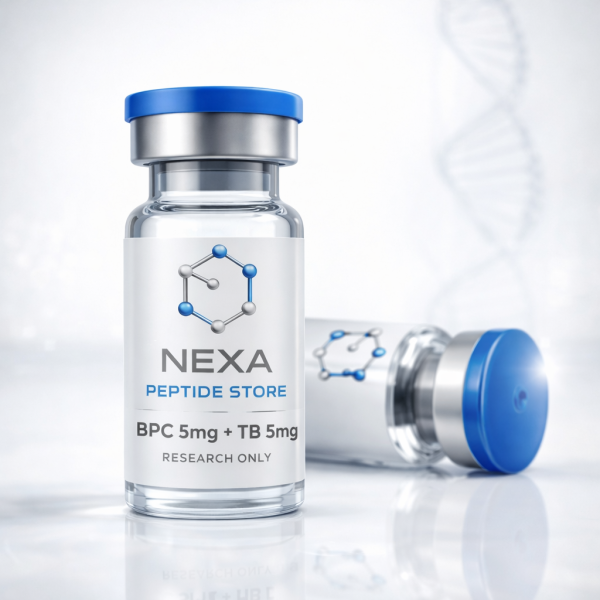
BPC-157 + TB-500 Blend
$80.00
For laboratory and in-vitro research use only. Not a drug. Not for human or veterinary use or consumption. This product has not been evaluated by the FDA and is not intended to diagnose, treat, cure, or prevent any disease.
The BPC-157 + TB-500 blend pairs two synthetic research peptides in one vial: BPC-157, a pentadecapeptide studied in preclinical models of tissue repair, and TB-500, a synthetic fragment related to Thymosin Beta-4 studied for wound healing and cell migration. Nexa Peptide Labs sells this blend strictly for laboratory and in-vitro research use; it is not an FDA-approved drug and is not evaluated for human use.
Ask around in any peptide research forum and you will find the same two names paired together constantly: BPC-157 and TB-500. Researchers combine them in study designs because the two compounds are proposed to act on overlapping repair pathways through different mechanisms, and a combined product saves a lab from managing two separate reconstitution schedules. This page covers what each compound is, what has actually been published about them, and what to check before you buy from any supplier claiming to sell a “BPC-157 TB-500 blend.”
What Is the BPC-157 + TB-500 Blend?
This product combines two peptides that are frequently studied together but are chemically distinct. BPC-157 (Body Protection Compound 157) is a synthetic pentadecapeptide derived from a fragment of a protein found in human gastric juice. TB-500 is a synthetic peptide corresponding to a fragment of Thymosin Beta-4, a naturally occurring protein involved in cell structure and migration. Combining them at 5mg and 5mg gives researchers a single product to work with when a study protocol calls for both compounds.
What Published Research Says About BPC-157
A 2025 systematic review in HSS Journal examined 36 studies on BPC-157, 35 of them preclinical and one clinical. The review reported that BPC-157 activated pathways including VEGF expression, ERK1/2 and AKT signaling, and reduced markers of inflammation such as IL-6 and TNF alpha in animal models of tendon, ligament, muscle, and bone injury. The same review noted no acute toxicity across liver, kidney, and brain tissue at doses up to 20 mg/kg in the animal studies examined, and stated plainly that human safety data remains absent from published literature.
What Published Research Says About TB-500
A 2026 scoping review in Applied Sciences analyzed 80 studies on Thymosin Beta-4 and TB-500, drawn from 1,772 identified records. The review found that most published evidence covers wound healing, vascular, and ocular applications rather than musculoskeletal tissue, and that direct TB-500 evidence specifically was limited to a single mixed study on metabolite profiling and fibroblast wound healing. The authors reported finding no human interventional studies of administered TB4 or TB-500 in tendon, ligament, muscle, bone, or cartilage research.
BPC-157 + TB-500 Blend Specifications and Comparison
The table below compares the BPC-157 + TB-500 blend against the two standalone peptides in the same catalog category, for researchers deciding whether a combined product or single compounds fit a given protocol.
| Attribute | BPC-157 + TB-500 Blend | BPC-157 (standalone) | TB-500 (standalone) |
|---|---|---|---|
| Peptide content | BPC-157 5mg, TB-500 5mg | BPC-157 only | TB-500 only |
| Purity (HPLC verified) | 98% or higher | 98% or higher | 98% or higher |
| Analytical verification | HPLC plus mass spectrometry | HPLC plus mass spectrometry | HPLC plus mass spectrometry |
| Certificate of Analysis | Included per batch | Included per batch | Included per batch |
| Format | Lyophilized powder | Lyophilized powder | Lyophilized powder |
| Price | $80.00 | See product page | See product page |
Related products: BPC-157 (standalone) product page and TB-500 (standalone) product page.
Purity, Certificate of Analysis, and Batch Testing
Every batch of this blend is verified to 98% or higher purity using HPLC, with mass spectrometry used to confirm molecular identity for both peptides in the mix. A Certificate of Analysis specific to the production batch is available on request. Researchers purchasing for a funded study or institutional protocol should request the COA before ordering, not after. See the Certificate of Analysis and lab testing page for sample reports and testing methodology.
Sourcing the BPC-157 TB-500 Blend: What to Verify Before You Buy
A combined product like this one is harder to verify than a single compound, since a buyer has to trust that both peptides in the vial are what the label says, not just one. Complaints about underdosed blends, where a listing claims 5mg and 5mg but the actual ratio is off, show up often enough in research peptide communities that it is worth treating as a real risk rather than a rare exception.
Before buying a BPC-157 TB-500 blend from any supplier, it is worth confirming three things. First, does the Certificate of Analysis cover both peptides individually, not just a combined purity figure. Second, was the COA generated for the specific batch being shipped, rather than a generic template reused across listings. Third, will the supplier provide that documentation before purchase, not only after a complaint.
Storage and Handling for Research Use
Store the lyophilized blend at minus 20 degrees Celsius or colder, protected from light and moisture, until it is used in a laboratory protocol. Repeated freeze thaw cycles reduce peptide integrity, so researchers typically aliquot on receipt rather than repeatedly accessing a single vial. As with any peptide reagent, handling should follow your institution’s standard laboratory safety procedures; this product is not labeled or supplied with directions for human administration.
Buying the BPC-157 + TB-500 Blend From Nexa Peptide Labs
The BPC-157 TB-500 blend is for sale in single vials and bulk wholesale quantities to laboratories, contract research organizations, and academic institutions. Every order ships with batch documentation, and volume pricing is available for CROs and institutional buyers purchasing on a recurring basis. Researchers outside the United States, including Canada, Germany, and France, should confirm import and customs requirements for research peptides in their own country before ordering. See the research use policy page and the shipping and fulfillment FAQ for details.
Frequently Asked Questions
What is the BPC-157 TB-500 blend used for in research?
It is used in laboratory studies examining tissue repair pathways, angiogenesis, and cell migration mechanisms, most often in preclinical models. It is a research reagent, not a treatment, and this page does not describe it as a therapy for any human condition.
Is the BPC-157 TB-500 blend approved for human or veterinary use?
No. Neither BPC-157 nor TB-500 is an FDA-approved drug, and this product is not evaluated, labeled, or sold for human or animal use or consumption. It is sold exclusively for laboratory and in-vitro research applications by qualified buyers.
What is the difference between BPC-157 and TB-500?
BPC-157 is a synthetic pentadecapeptide derived from a fragment of a gastric protein, while TB-500 is a synthetic peptide related to Thymosin Beta-4. They are studied through different proposed mechanisms; researchers combine them in some study designs because their pathways are thought to overlap rather than because they are the same compound.
What does current published research show for BPC-157?
A 2025 systematic review in HSS Journal covering 36 studies (35 preclinical, one clinical) found BPC-157 activated VEGF, ERK1/2, and AKT pathways in animal models of musculoskeletal injury, with no acute toxicity reported in the animal studies reviewed. The same review noted that human safety data is absent from published literature.
What does current published research show for TB-500?
A 2026 scoping review in Applied Sciences covering 80 studies found that direct TB-500 evidence is limited to a single mixed study, and that no human interventional studies of administered TB4 or TB-500 exist in tendon, ligament, muscle, bone, or cartilage research categories.
Is it legal to buy BPC-157 and TB-500 for research purposes?
Research peptides sold with accurate research use only labeling, and marketed without human use or therapeutic claims, can generally be purchased by qualified buyers for laboratory use. Regulatory status is actively changing: the FDA’s Pharmacy Compounding Advisory Committee reviewed BPC-157 and TB-500 on July 23, 2026 for possible inclusion on the 503A Bulk Drug Substances List, a process covered directly on the FDA’s Pharmacy Compounding Advisory Committee meeting page. Buyers should independently confirm current requirements in their own jurisdiction.
What does a Certificate of Analysis show for a two peptide blend?
For a combined product, a proper COA documents purity and identity testing for each peptide separately, by HPLC and mass spectrometry, along with the batch or lot number. A single combined purity figure without per compound detail is not sufficient to verify a blend.
How should the BPC-157 TB-500 blend be stored, and what is its shelf life?
Store the lyophilized peptide blend at minus 20 degrees Celsius or colder, away from light and moisture. Properly stored lyophilized peptide is generally stable for an extended period; researchers should aliquot on receipt to avoid repeated freeze thaw cycles, which shorten usable shelf life.
Do you ship the BPC-157 TB-500 blend to Canada, Germany, or France?
Nexa Peptide Labs fulfills United States orders directly and supports international peptide distributors; researchers outside the United States should confirm current import and customs requirements for research peptides in their own country before ordering.
Can I buy the BPC-157 TB-500 blend in bulk or wholesale quantities?
Yes. The blend is available for sale in single vials and bulk wholesale quantities, with volume based pricing for CROs, academic labs, and institutional buyers.
What purity level should I expect when I buy a BPC-157 TB-500 blend online?
Reputable suppliers verify purity for each peptide in the blend by HPLC and provide a batch specific COA covering both compounds. Nexa Peptide Labs lists 98% or higher HPLC verified purity for each peptide in this blend; buyers comparing vendors should request the COA before purchase rather than relying on the listing alone.
Reviewed by, Nexa Peptide Labs Science and Quality Assurance Team.
Last updated: September 2, 2026.
Sources: Vasireddi et al., “Emerging Use of BPC-157 in Orthopaedic Sports Medicine: A Systematic Review,” HSS Journal, 2025. McGuire, Hughes, Maak, and Cushman, “Thymosin Beta-4 and TB-500 in Tissue Healing, Regeneration, and Musculoskeletal Repair: A Scoping Review,” Applied Sciences, 2026. FDA, Pharmacy Compounding Advisory Committee Meeting, July 23 to 24, 2026.
8 reviews for BPC-157 + TB-500 Blend
Only logged in customers who have purchased this product may leave a review.
Related products

CJC-1295 Without DAC 5mg+IPA
$85.00BPC 10mg + TB 10mg
$100.00Cagrilintide 5mg + Semaglutide 5mg
$100.00
Dylan (verified owner) –
Great value and premium-grade products.
Samuel Wright (verified owner) –
Fast shipping and excellent communication.
Chris Taylor (verified owner) –
Professional service from start to finish.
James Anderson –
Absolutely fantastic results with BPC 5mg + TB 5mg. Recovery time has significantly improved. Highly recommend!
Sarah Miller –
Good quality product. Noticed a difference within the first week. Shipping was fast too.
Robert Wilson –
The best combo for joint health. Nexa Peptide Labs never disappoints with their purity.
Emily Davis –
Solid product, works as described. Will be ordering again soon.
Michael Brown –
Incredible for post-surgery recovery. My physical therapist was amazed at the progress.